


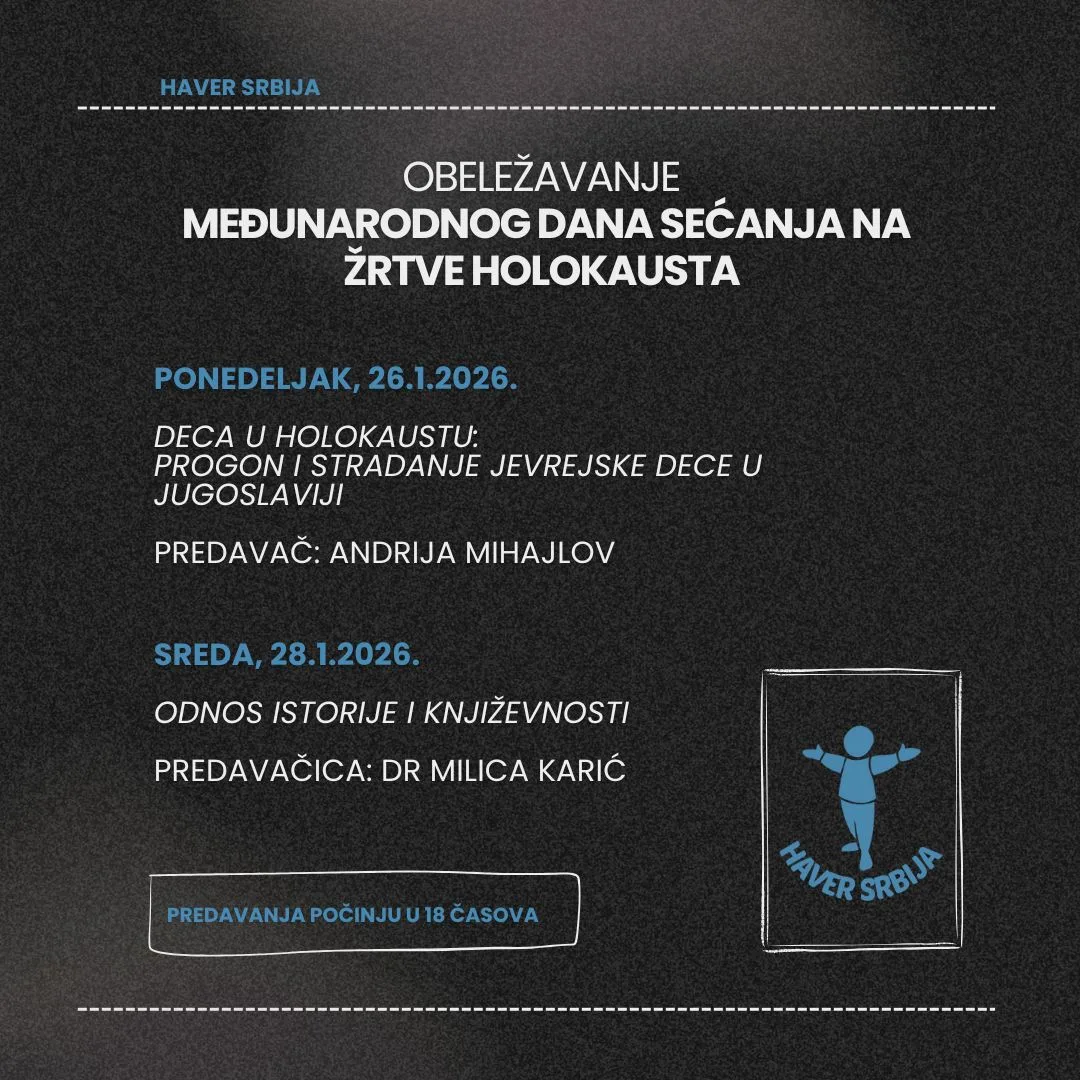
On the occasion of International Holocaust Remembrance Day, observed on January 27, the Haver Association Serbia is organizing two lectures. We invite you to join us on Monday, January 26 and Wednesday, January 28 at 6 PM to commemorate this date through shared learning.
Monday: January 26, 2026 at 6 PM
Lecture
:
Children in the Holocaust: Persecution and Suffering of Jewish Children in Yugoslavia
, Andrija Mihajlov
Wednesday, January 28, 2026 at 6 PM
Lecture
:
The Relationship Between History and Literature
, Dr. Milica Karić
To participate in the program, please fill out the
Application Form
by no later than
the end of the day on January 22
. The number of places is limited to 20 people. On Friday, January 23, we will inform you about the outcome of your application.
January 27 was declared International Holocaust Remembrance Day by a resolution of the United Nations General Assembly adopted on November 1, 2005. On that day in 1945, units of the Red Army liberated the largest death camp, Auschwitz - Birkenau in Poland.
More about the lectures:
Lecture:
Children in the Holocaust: Persecution and Suffering of Jewish Children in Yugoslavia
The lecture will cover the main phases of the persecution of Jewish children during the Holocaust in Yugoslavia, from gradual exclusion from society to deportations and mass suffering. Special attention will be paid to the forms of violence that children were exposed to and their survival possibilities.
Andrija Mihajlov (1997) is a research intern at the Institute for Philosophy and Social Theory at the University of Belgrade and a doctoral student in the history department of the Faculty of Philosophy in Belgrade. He completed his undergraduate and master's studies in history at the history department of the Faculty of Philosophy in Niš. As a researcher, he is part of Shoahlaba – the Laboratory for Holocaust Research. His research interests focus on the history of the Holocaust, antisemitism, and the ideology of National Socialism.
Lecture:
The Relationship Between History and Literature
This lecture will address questions of the representation of the Holocaust in literature. It will examine the ways in which the Holocaust is written about, as well as the question of whether and where the boundaries between factuality and literary imagination exist, and to what extent historiographical facts are respected in literary works. Special attention will be given to the question of whether, and under what conditions, it is possible to speak about the aesthetic experience in Holocaust literature and about the Holocaust itself, without compromising ethical responsibility towards the subject. In the lecture, we will reflect on some well-known, as well as lesser-known works, and compare the different approaches taken by writers of various backgrounds and experiences in addressing this topic.
Milica Karić was born in Kragujevac in 1988. She graduated from the Faculty of Philology and Arts in Kragujevac in the Department of English Language and Literature, where she also obtained her PhD in 2022 with a thesis on the Fictionalization of the Holocaust in the novels of Jerzy Kosinski, Jane Yolen, and D. M. Thomas. Since 2023, she has been working at the Museum of Genocide Victims as a curator responsible for two archival collections related to the suffering of Jews: the Beraha Family Collection and the "Judaica" Collection. She has been dealing with the topic of the Holocaust and the culture of remembrance since 2010 through educational work with primary and secondary school students as well as through scientific activities.